
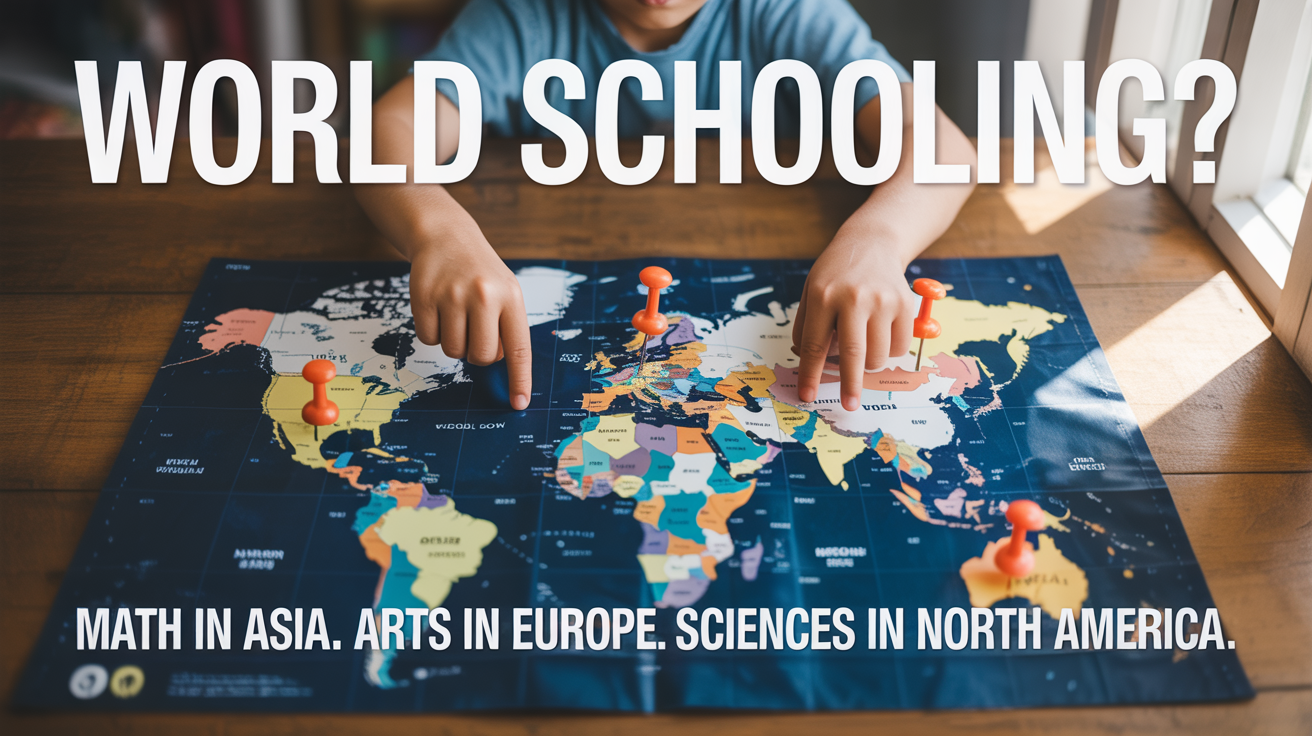
More families are coming across the idea of world schooling lately. Some scroll past it. Others pause and wonder what it really means.
World schooling isn’t just another education trend. It’s part of a broader movement in global learning and family travel education — a response to something parents already know: traditional schooling, on average, has failed to prepare kids for the world they’re actually growing up in.
Here’s what world schooling is, why it works, and how it gives your family something most others won’t have: perspective.
What World Schooling Actually Means
World schooling, sometimes called travel-based learning, is education through experience — specifically, through exposing kids to different countries, cultures, and economic systems.
It can look different for every family. Some travel full-time. Others take extended trips a few times a year. Some enroll their kids in local schools in different countries for short periods. Others skip formal schooling entirely and let the world teach.
The common thread? Kids learn by being in the world, not just reading about it — learning through travel, not textbooks.
There’s a growing community around this — one of the main Facebook groups has over 62,000 families. World schooling hubs have popped up in places like Portugal, Bali, Costa Rica, and Egypt, where families gather for 4–6 week sessions. Kids get structured activities for a few hours each day while parents work remotely. Then afternoons and weekends are for cultural experiences.
But you don’t need a hub or a community to start. You just need to understand why it matters.
The World Your Kids Are Growing Up In
We’re heading into a multipolar world mixed with AI — and no one knows how far it’ll go.
The rules are changing. The systems are changing. The skills that mattered in your career might be irrelevant in ten years.
Don’t be the general fighting the last war.
Most parents exploring alternative education or joining world schooling families already know traditional schooling is failing. The issue isn’t just test scores or curriculum — it’s the entire setup. One authority at the front of the room. One expected answer. Kids measured by how well they can replicate what that authority wants.
That’s not thinking freely. That’s becoming a cog in a machine.
And here’s the thing — no parent wants that for their kids. But it ends up being that way when the family only knows one way of doing things.
If you only know how one economy works, how one culture operates, how one system is structured — that’s the lens your kids will use to see everything. They’ll grow up thinking there’s one right way to do things.
World schooling breaks that.
What My Kids Actually Learn
We’re doing this. We’ve taken our kids to different countries as part of our worldschooling journey, and the biggest aha moments aren’t about facts or curriculum.
It’s when they realize there are different cultural norms and languages — and that they have the social skills to navigate the situation.
I watched this happen at a playground in a new country. My kids had to figure out how to communicate, how to play by different unspoken rules, how to adapt. No teacher. No script. Just them working it out.
That’s not something you can teach in a classroom — it’s the kind of real-world education traditional schools can’t replicate.
Later on, we plan to isolate specific subjects and select where they’re taught most effectively. Maybe it’s math in Asia. Arts in Europe. Sciences in North America. We’ll see. Right now, they’re young, and the focus is on exposure and adaptability.
But the principle is the same: knowing how different regions work gives you options others don’t have.
How This Applies Even For Grownups
I run a few businesses across different continents. That same global perspective I want for my kids helps me build my portfolio smarter.
I can hold long-term real estate in a region with zero capital gains taxes and go for high-appreciating assets rather than cash flow. I can run more active businesses where banking is developed. I can venture into areas where yield is high and competition is low for alpha.
That only works because I understand how different economies operate.
Your kids will face the same choices — not just in business, but in how they think, where they live, what opportunities they see. That’s why world schooling prepares kids for the future of work and life in a global economy.
If they only know one system, they’ll only see one set of options. If they know how different regions work, they’ll see opportunities others miss.
How To Think About World Schooling
You don’t have to quit your job and travel full-time. You don’t need to pull your kids out of school tomorrow.
World schooling can be a supplement — even a form of homeschooling while traveling. A few weeks in another country each year. Summer trips that focus on cultural immersion instead of resorts. Even local experiences — visiting cultural centers, trying new languages, meeting people from different backgrounds.
The point isn’t the travel itself. It’s the global mindset — the ability to see different systems, cultures, and possibilities.
That perspective is what prepares them for a future no one can predict.
Traditional schooling was built for a world that doesn’t exist anymore. A world where you learned one skill, worked for one company, retired with a pension.
That’s gone.
The future is multipolar, decentralized, and rapidly changing. The kids who thrive won’t be the ones who memorized the right answers. They’ll be the ones who can adapt, think critically, and see opportunities in systems others don’t understand.
World schooling gives them that.
Where To Start
If you’re curious about how to start world schooling, start small. Plan a trip focused on cultural immersion and learning through travel, not just sightseeing. Let your kids navigate a new place. Watch what happens.
If you want to go deeper, there are world schooling hubs you can join for a few weeks. Families gather in places like Portugal, Costa Rica, and Bali. Kids get structured learning in the mornings, cultural experiences in the afternoons, and parents can work remotely.
Or you can do what we’re doing — design your own version. Mix and match what works for your family.
The key is starting — because the longer you wait, the more your kids get locked into one way of seeing the world. And once that happens, it’s hard to undo.
World schooling gives your family the freedom to raise globally minded, adaptable kids ready for a decentralized, fast-changing future.
If you want to explore how this could work for your family — or if you’re already traveling and want to structure it better — send me an email at Mike@TotalFreedom.io. I’ll connect you with the right people in our network.